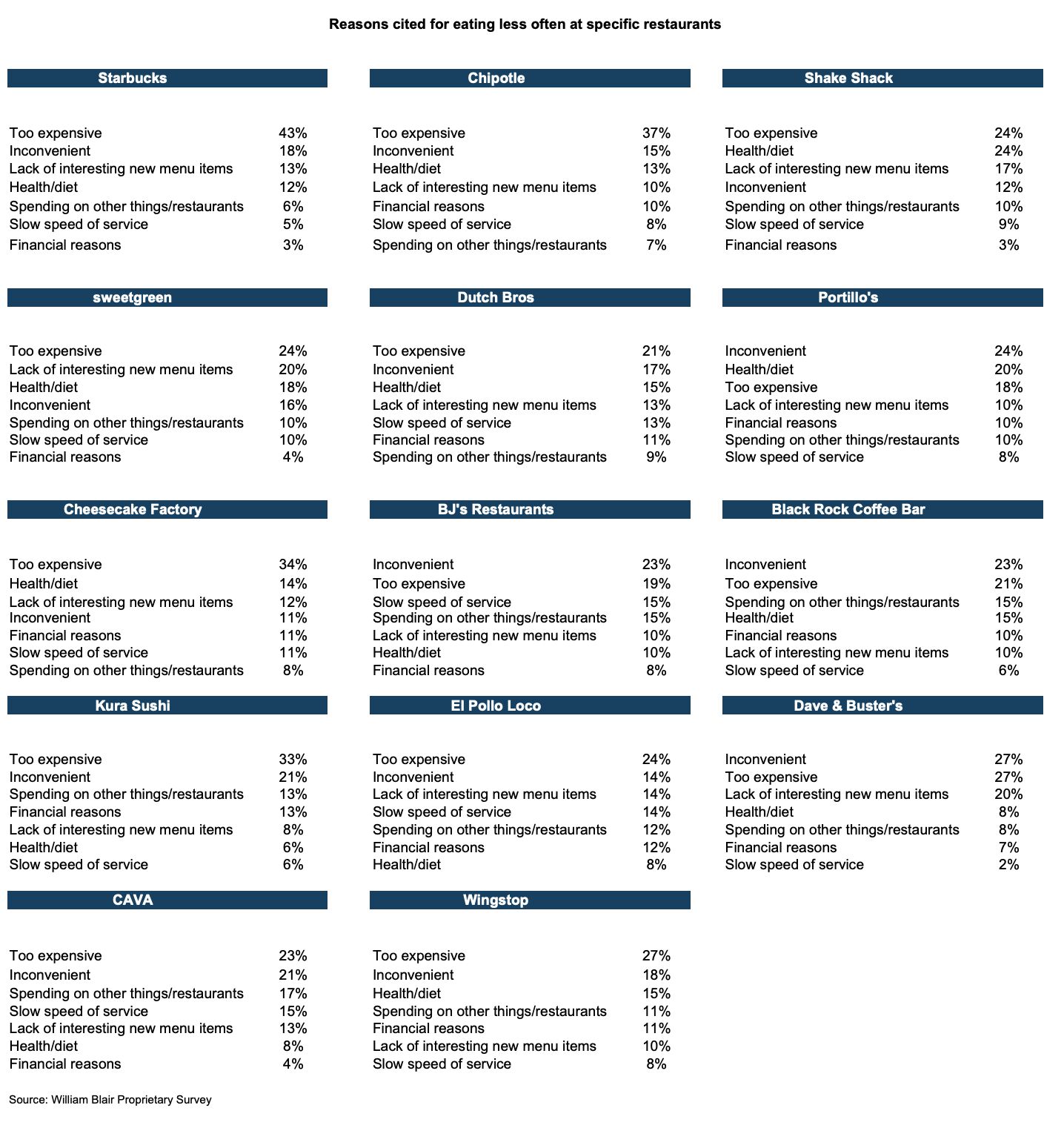
William Blair just released their 15th quarterly restaurant engagement survey. Danny Klein at QSR Magazine has the full breakdown here.
The headline finding: more than 70 percent of consumers cite “too expensive” as the reason they are eating less often at specific restaurants.
The industry will read this as a pricing problem. It is not.
“Too expensive” is a relationship problem wearing a price tag.
Here is what the data is actually showing.
When a Guest visits frequently, the price is rarely the issue. The regular who comes in twice a week is not running a cost-benefit analysis every time they walk through the door. The relationship has compounded to the point where the experience justifies the investment without deliberation. Price becomes invisible inside a strong relationship.
When visit frequency declines, the calculation changes. The Guest who used to come in without thinking now considers it. And the moment they start considering it, the price that was previously acceptable starts to feel wrong. Not because the price changed. Because the relationship value did.
Danny Klein notes this directly: a brand can be perceived as too expensive when visit frequency is declining, even if the price has not moved.
The price did not become the problem. The relationship became the problem. The price just surfaced it.
This is the distinction most operators miss. And it is the distinction that determines whether your response to “too expensive” actually works.
The Road 1 response: discount. Promote. Add value meals. Run a limited time offer. Reduce the price until the Guest comes back.
The problem with the Road 1 response: it confirms the Guest’s frame. When you discount, you are telling the Guest that your experience is transactional and transactions should cost less. You have trained them to wait for the deal. The next time they consider visiting, they will wait again. The relationship does not deepen. The discount dependency does.
The Road 2 response: deepen the experience until the price is irrelevant to the relationship.
The Guest who feels genuinely known, whose preferences are remembered, whose experience is personalized, whose visit feels like a relationship rather than a transaction, does not cite price as a reason to visit less. They cite price as a reason to visit less at somewhere else.
The independent operator has a structural advantage here that no chain in this survey can replicate at scale. The chain cannot tell 3,000 locations to individually know their Guests. The independent already does. The chain cannot give every cast member the relational authority to make the experience feel personal. The independent already has it.
The Chipotle data confirms the argument. Their “too expensive” number is improving according to William Blair. The industry is reading this as good news. The Road 2 read: Chipotle has temporarily reduced the visibility of a relationship problem by adjusting price perception. The moment they raise prices again, the number returns. They have not solved the problem. They have paused it.
The independent operator who reads this survey and reaches for a discount is making the same mistake at a smaller scale with less margin to absorb it.
Do not lower your price. Raise the value of the relationship until the price stops being the question.
That is the only response that compounds.